
How Stress Affects Your Gut and Hormones: An Ayurvedic & Scientific Perspective
A Samarpitam Ayurveda Insight into Modern Lifestyle Disorders 🌿Why Are So Many People Digestively and Hormonally Imbalanced Today? Have you ever noticed this? You eat the same food…But suddenly you feel bloated. Your reports say “normal”…But your periods are irregular, your digestion feels heavy, your sleep is disturbed, and your mind never truly rests. You

samarpitamchikitsalaya@gmail.com
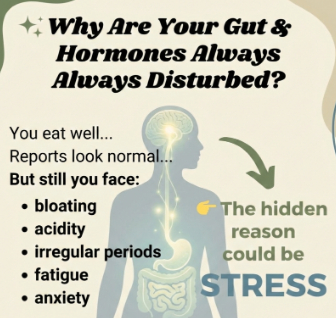
A Samarpitam Ayurveda Insight into Modern Lifestyle Disorders
🌿Why Are So Many People Digestively and Hormonally Imbalanced Today?
Have you ever noticed this?
You eat the same food…
But suddenly you feel bloated.
Your reports say “normal”…
But your periods are irregular, your digestion feels heavy, your sleep is disturbed, and your mind never truly rests.
You try supplements.
You change diets.
You even take medicines.
Yet something still feels off.
At Samarpitam Ayurveda, we often tell our patients:
“The problem may not be in what you eat — but in how your body is responding under stress.”
Modern science now confirms what Ayurveda explained thousands of years ago:
👉 Stress directly alters digestion, gut health, and hormonal balance.
This blog explores how stress affects your gut and hormones, explained through modern medical science (allopathy) and classical Ayurvedic wisdom, in a way the human mind can truly understand.
Understanding Stress: Not Just Mental, But Biological
Modern Medical View
Stress is not merely an emotional experience. When the brain perceives stress, it activates a powerful hormonal cascade known as the HPA axis (Hypothalamic–Pituitary–Adrenal axis).
This results in the release of cortisol, commonly called the stress hormone.
Short-term cortisol is protective — it helps us respond to danger.
But chronic stress, which is common in modern lifestyles, keeps cortisol elevated for long periods, leading to:
- impaired digestion
- altered gut motility
- inflammation
- hormonal suppression
- metabolic imbalance
This is now a well-established concept in neuroendocrinology.
Ayurvedic Understanding
Ayurveda clearly states that:
Chinta (overthinking), Bhaya (fear), Shoka (grief), and Krodha (anger) directly weaken Agni — the digestive fire.
Charaka Samhita explains:
“Agni is the root of health. When Agni is disturbed, disease begins.”
In Ayurvedic terms:
- Chronic stress → Agnimandya (weak digestion)
- Weak digestion → Ama (toxic metabolic waste)
- Ama → Srotorodha (channel blockage)
- Blocked channels → Hormonal and systemic disorders
Modern cortisol theory and Ayurvedic Agni theory describe the same physiological breakdown, using different languages.
The Gut–Brain Axis: Where Science Meets Ayurveda
Scientific Explanation
Modern medicine recognizes the gut–brain axis, a two-way communication system between:
- the brain
- the nervous system
- the gut lining
- immune cells
- gut microbiome
Nearly 90% of serotonin (the happiness neurotransmitter) is produced in the gut.
This explains why stress can immediately affect:
- appetite
- bowel habits
- bloating
- acidity
- abdominal discomfort
And why gut problems often create anxiety and low mood.
Ayurvedic Explanation
Ayurveda described this connection long before modern science through:
- Manovaha Srotas – channels of the mind
- Annavaha Srotas – channels of digestion
Ayurvedic texts explain that these two systems are interdependent.
Disturbance of the mind disturbs digestion.
Disturbed digestion further disturbs the mind.
This is exactly what modern science now calls the bi-directional gut–brain axis.
Stress and Leaky Gut: Ama in Modern Language
Scientific View
Research shows that psychological stress increases:
- intestinal permeability (commonly called leaky gut)
- mast cell activation
- inflammatory cytokines
This allows partially digested food particles and toxins to enter the bloodstream, triggering:
- inflammation
- food sensitivities
- autoimmune tendencies
- chronic fatigue
Ayurvedic Correlation
Ayurveda describes this condition as Ama formation.
When Agni is weak:
- food is not properly digested
- sticky, toxic residue forms
- this Ama circulates through the body
Ama behaves very similarly to inflammatory endotoxins described in modern medicine.
Thus:
Leaky gut = impaired Agni + Ama circulation
This is why Ayurveda always treats digestion before treating hormones.
Stress and the Gut Microbiome
Modern Science
Chronic stress has been shown to:
- reduce microbial diversity
- alter beneficial bacteria
- disturb immune tolerance
- worsen inflammatory responses
Studies on germ-free models demonstrate exaggerated stress hormone responses, proving that a healthy microbiome helps regulate stress.
Ayurvedic Wisdom
Ayurveda emphasizes:
- Ahara (diet)
- Vihara (lifestyle)
- Kala (biological timing)
Irregular eating, late nights, emotional eating, and suppression of natural urges disturb gut balance.
This is described as Viruddha Ahara and Vihara, which ultimately leads to disease.
Once again, science is confirming ancient Ayurvedic principles.
Stress and Hormonal Imbalance
Allopathic Understanding
Chronic stress suppresses the HPG axis (Hypothalamic–Pituitary–Gonadal axis).
This leads to:
- irregular menstrual cycles
- worsened PMS
- reduced ovulation
- low progesterone
- estrogen imbalance
- reduced testosterone in men
- thyroid hormone conversion disturbances
The body prioritizes survival over reproduction during stress.
Ayurvedic Explanation
Ayurveda explains hormonal imbalance through Dhatu nourishment.
The body tissues are formed sequentially:
Rasa → Rakta → Mamsa → Meda → Asthi → Majja → Shukra / Artava
If digestion and mental health are disturbed:
- proper nourishment of deeper dhatus stops
- reproductive tissues become weak
- hormonal imbalance develops
This is known as Dhatu Kshaya due to Agnimandya and Manasika Nidana.
Why Stress Worsens PCOS, Thyroid, IBS & PMS
Modern research confirms stress as a strong aggravating factor in:
- PCOS
- IBS
- hypothyroidism
- autoimmune conditions
- menstrual irregularities
Ayurveda explains this through Vata and Pitta aggravation.
- Anxiety increases Vata
- Anger increases Pitta
- Poor digestion increases Kapha stagnation
This tridoshic imbalance creates chronic lifestyle disorders.
The Samarpitam Ayurveda Healing Philosophy
At Samarpitam Ayurveda, we do not treat only reports or hormones.
We focus on:
- correcting Agni
- calming the nervous system
- removing Ama
- restoring circadian rhythm
- strengthening mind–body connection
Because true healing begins at the root.
Integrative Healing: Where Ayurveda and Science Walk Together
| Modern Science | Ayurvedic Principle |
|---|---|
| Cortisol rhythm | Dinacharya |
| Gut–brain axis | Manas–Agni connection |
| Microbiome health | Agni + Pathya Ahara |
| Anti-inflammatory care | Ama Pachana |
| Nervous system regulation | Pranayama & Abhyanga |
Conclusion: Ancient Wisdom Validated by Modern Science
Stress is not only a mental burden.
It is a biological force that alters digestion, immunity, and hormones.
Ayurveda understood this truth thousands of years ago.
When Agni is balanced, the gut heals.
When the gut heals, hormones align.
When hormones align, the mind becomes calm.
At Samarpitam Ayurveda, we believe:
Healing is not about suppressing symptoms — it is about restoring harmony within.
Scientific References
- Mayer EA. The Gut–Brain Axis. Gastroenterology.
- Cryan JF, Dinan TG. Mind-altering microorganisms. Nature Reviews Neuroscience.
- Konturek PC et al. Stress and the gut. Journal of Physiology and Pharmacology.
- Sapolsky RM. Stress and hormone disruption. Endocrine Reviews.
- Turnbaugh PJ et al. The human microbiome project. Nature.
- Smith SM, Vale WW. The role of the HPA axis. Endocrine Reviews.
- Chrousos GP. Stress and disorders of the stress system. Nature Reviews Endocrinology.
- Kelly JR et al. Gut microbiota and mental health. Molecular Psychiatry.
This blog is for educational purposes and does not replace personalized medical consultation.
Emergency? Contact Us


